
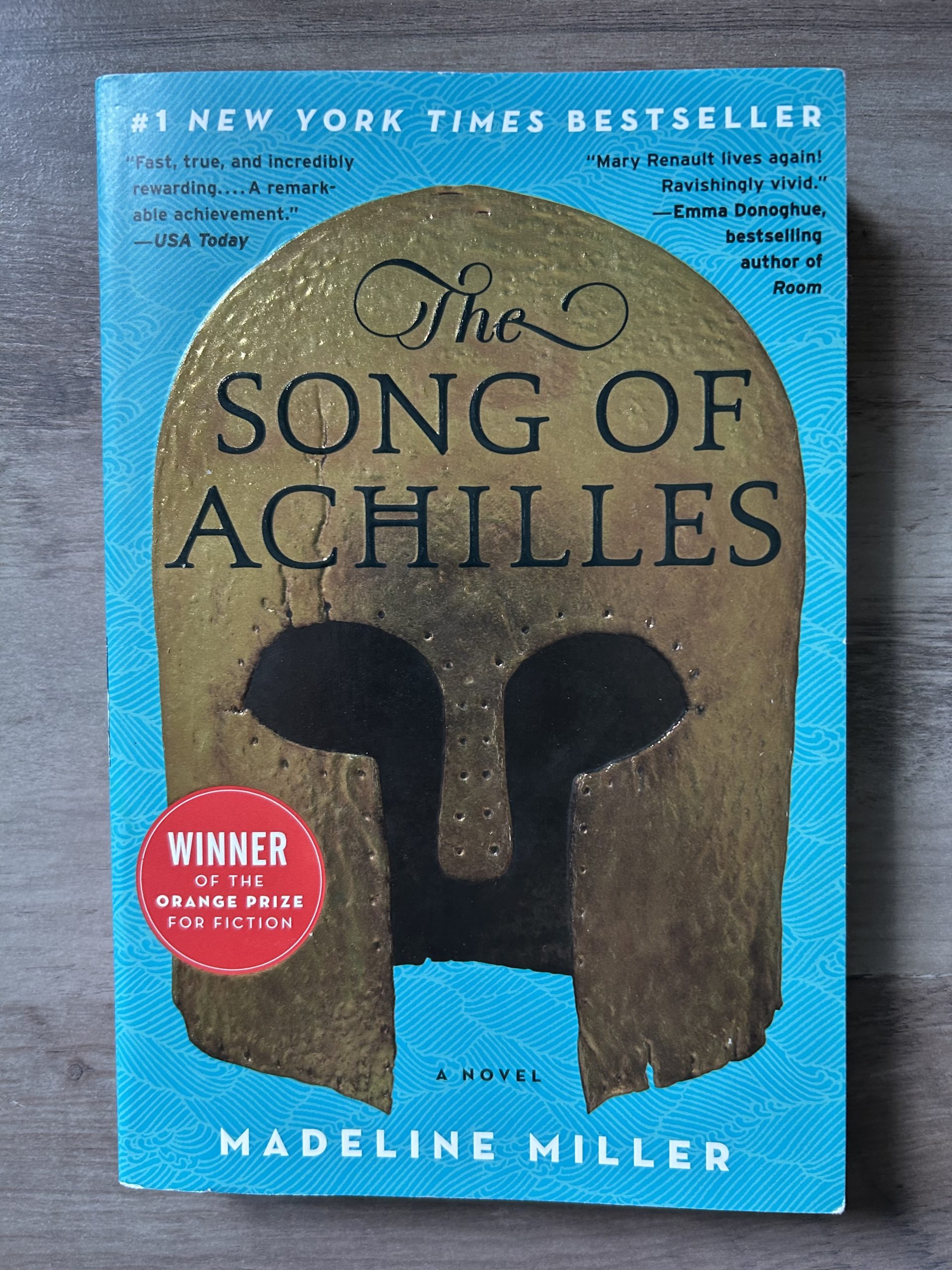
I’ve never been someone who was too engrossed in Greek mythology, or any mythology for that matter, but I couldn’t ignore all of the raving reviews that I’ve heard about this novel. I am pleased to report that this book met, and even exceeded, my expectations.
“There are no bargains between lion and men. I will kill you and eat you raw.”
Premise of the book:
When the young and awkward Patroclus is exiled from his home, he finds refuge in the kingdom of Phthia. It is there that he finds Achilles, son of sea goddess Thetis. Patroclus and Achilles form a close bond, one closer than even they could imagine. As they grow and train together, word gets out that Helen of Sparta has been kidnapped. With Achilles being called to fulfill his prophecy of being one of Greece’s greatest warriors, Patroclus knows he must follow Achilles into the war. However, the war turns out to be more deadly than either could have imagined.
“He is a weapon, a killer. Do not forget it. You can use a spear as a walking stick, but that will not change its nature.”
Pros/positives:
*Writing style*
I appreciated how the author ensured that you didn’t have to know Greek mythology before reading this book. While I’ve heard of some names of the characters from the internet and such, I wasn’t really familiar with most of them when I first picked up this book. However, I found that as I read, my lack of knowledge in that field didn’t matter, as the author put it in a comprehensible state.
The author’s writing was often deep and very poetic. She used a magnitude of literary devices, with her using similes and imagery the most. The way she describes Patroclus’ and Achilles’ love for one another is almost lyrical. With the way Patroclus admits to himself that he would be able to recognize Achilles blind “by the way his breaths came and his feet struck the earth”, or how he “would know him in death, at the end of the world” (134). The way in which the author went about portraying Patroclus’ feelings never fell short of beautiful.
*Romance*
The romance between Patroclus and Achilles was a journey to go through, but one I do not regret. We could see the relationship between the two develop and mature as the boys grew up into men. When it first started, both of them were scared, with Achilles even running away after they kissed for the first time. However, over time, their relationship blossomed into more, and they stopped trying to hide themselves from the world.
Best of all, their relationship wasn’t perfect, but it wasn’t unsalvageable either. They fought with each other, albeit not often, and they strived to try to resolve their arguments. In one of the cases, Patroclus was upset at Achilles for falling for his mother’s lies. Patroclus was ready “to reproach [Achilles] for his naïveté”, for Patroclus believed Achilles “trusted too easily” (135), but just a page later, Patroclus realized his unfairness. Patroclus even went as far as to tell Achilles that there was “nothing to forgive” (136) when Achilles tries apologizing.
Another cute detail is how Achilles is humanized through Patroclus’ eyes, since the novel is written in the POV of Patroclus. As someone with minimal background knowledge on Greek mythology, I’ve only ever known that Achilles is a strong hero. Patroclus changed that, revealing to the readers Achilles’ vulnerabilities and flaws. The beginning of the book, when they were children, has the most sections where Patroclus realizes that Achilles is more than just a person destined for greatness, but also a child. One of the scenes I remember is after Patroclus met Achilles’ mother for the first time. Patroclus tells Achilles that his mother wants him to be a god, and Patroclus notices Achilles’ face “twist with embarrassment”, making Patroclus note how it was “a boyish response. And so human” (55).
*Characters*
With the relationship between the two main characters developing nicely, I can cherish the fact that both of the main characters of the story grew individually as well. One is destined for greatness, while the other is an exiled noble. While in the beginning, you can notice Achilles step away from his role of becoming a great Greek warrior, with it going as far as Achilles running away from his responsibilities. However, as the book progresses, Achilles’ want for fame and honor overtakes his original disinterest. We can see this shift when Achilles chooses the path that led to his glory over the path that led to a long life.
Meanwhile, Patroclus goes from being a traumatized child to a devoted companion of Achilles. Yet, Patroclus also manages to break off from being known as just Achilles’ sidekick when he decides to be a hero of his own.
The side characters were also interesting to me, even though I didn’t feel nearly as attached to any of them as I did to Patroclus and Achilles. I found that they each taught me more about Greek mythology. One of the side characters that captivated my attention was Achilles’ mother, Thetis. Her motivations were often corrupt and selfish. She made sure to let Patroclus know how much she hated him. She even went as far as to tell him, “You will be dead soon enough” (54) when she first met him. Yet, you could tell she cared for her son and wanted what was best for him in the end.
*Plot*
I can’t go into the plot without first discussing how perfect the ending was. It left me satisfied and feeling as though Patroclus and Achilles’ stories wrapped up nicely. The author did a great job in showing how the characters’ flaws are what led to their downfall.
I believe that the second half of the story was more addictive than the beginning. Even though I knew how the book was going to end, I was still on the edge of my seat, hoping for a different outcome.
The second half of this novel is where the pacing picked up, allowing the plot to take bigger steps forward in each chapter. The chapters themselves were of good length throughout the whole book.
“We are all there, goddess and mortal and the boy who was both.”
Cons/negatives:
*A lot of names*
While this book put Greek mythology in an easy-to-understand way, the beginning was still a little overwhelming for me. Many, many different nobles and royals were named in the first couple of chapters, and I didn’t know which ones I needed to remember versus which ones would never be mentioned again. The glossary in the back was helpful, but it was still intense to get a bunch of names thrown at me.
After I got a little way into the book, this problem became less and less prominent, yet there were still some moments where a name would draw a blank for me, or sometimes I’d need to flip to a different chapter to refresh my memory on who someone was.
*Slow start*
It took me a few chapters to actually get into the story. The start wasn’t the most exciting or memorable, but you grow to appreciate it once you continue through the book.
Same with how the first half of the story seemed to be paced more slowly than the rest of the novel. This is due to the fact that the author needs to introduce and set up many new characters, all while allowing two boys to grow up into warriors. However, there were a few times in the first few chapters where I had to keep pushing myself to turn to the next page.
“There is no law that gods must be fair, Achilles,” Chiron said. “And perhaps it is the greater grief, after all, to be left on earth when another is gone”
Conclusion:
Pros – Writing style, romance, characters, plot
Cons – A lot of names, slow start
Overall – 4.5 out of 5
“We were like gods at the dawning of the world, & our joy was so bright we could see nothing else but the other.”