
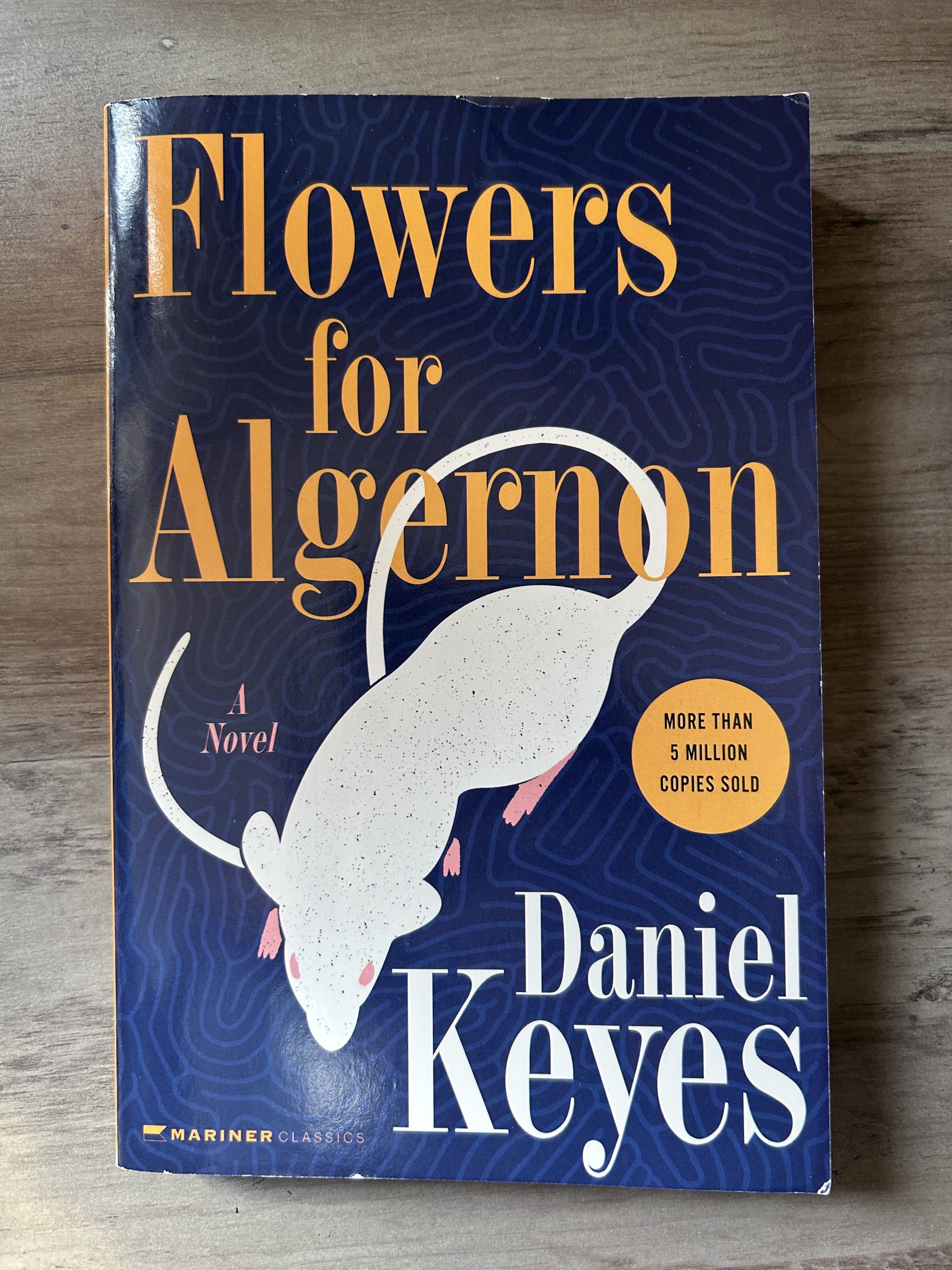
Throughout my years, I have tended to stray from books considered ‘classics’, for the sheer fact that I have been traumatized from my English classes (sorry to any of my English teachers–you guys were great, it’s me). I picked up this book with some hesitance, but I was too interested to let it go. After taking the chance of reading it, I am happy to say that it helped me heal in some ways from hating classic books.
“I don’t know what’s worse: to not know what you are and be happy, or to become what you’ve always wanted to be, and feel alone.”
Premise of the book:
Charlie Gordon is a 32-year-old man who is intellectually disabled. One day, he is found to be perfect for an experimental surgery, one that will hopefully raise his unusually low IQ. The experiment worked very well on a lab mouse named Algernon.
As Charlie grows to be even smarter than the doctors who made the experiment, he finds that his emotional intelligence is falling behind. This experiment is considered to be a success…until Algernon’s intelligence starts to rapidly decline. Now, Charlie is wondering what is going to happen to him.
“That’s the thing about human life–there is no control group, no way to ever know how any of us would have turned out if any variables had been changed.”
Positives:
*Main character and his development*
Charlie takes us on a journey. From the very start, the reader can see Charlie’s kind soul. He doesn’t like to lie; he is always ready to answer the questions thrown at him; he is constantly looking for new friends, etc. The author did an amazing job getting us to care about Charlie before the surgery. That means after the experimental surgery, we can notice how he changes as he gains IQ. My favorite growth was seeing his gained independence. He didn’t blindly rely on the researchers anymore, as he lost some of his naivety.
The author also did a great job showing the internal struggles that Charlie faced as he got smarter. He was basically split into two people: past-Charlie and present-Charlie. I loved the detail of how past-Charlie was holding present-Charlie back due to the emotional instability and trauma he dealt with as a child. He had to face those issues before he could actually grow. It was intriguing to watch him try to figure out his problems while also dealing with a growing IQ.
*Themes/issues faced in the book*
This book raised a lot of questions. It made me think about being happy and naive versus knowledge and isolation. I thought about IQ compared to emotional intelligence. It forced the readers to look at how people with disabilities are treated in the world.
Watching Charlie navigate through his emotions while his intelligence flies out of control was eye-opening. I never considered the fact that growing your smarts so quickly would cause your emotional intelligence to fall behind. Charlie was forced to face his childhood, which he now could see as abuse. He could now see that his coworkers at the bakery weren’t his friends but were making fun of him. He could no longer live in naivety.
It made me reflect on what it means to be in a society. We see that Charlie is still considered an outcast, even after his experimental surgery, because he was now too smart. It makes you think about what people consider ‘normal’ and what it takes to be accepted into society.
*Format*
The format of this book was brilliantly done. The author set it up as Charlie logging almost every day of his experience of gaining intelligence. We got to see him before and after the experiment. I loved how the author purposely misspelled words at the beginning of the story; then, once Charlie gained more IQ, bigger words were used, and the incorrect grammar was fixed. It was a nice detail that helped me immerse myself in the novel.
*Quick read*
This novel was the perfect size for me. It made an impact, despite not being ridiculously long or super complex. It was deep and thought-provoking. I appreciated how it managed to evoke my emotions. I felt for Charlie; whether it was happy, concerned, or upset, I felt it.
“A child may not know how to feed itself, or what to eat, yet it knows hunger.”
Neutral:
*Side characters*
The side characters were so close to being well-made for me. Alongside Charlie, they also changed with Charlie’s new intelligence: the scientists grew envious of what Charlie had, Alice felt inferior, and Charlie’s workmates were unsettled.
My issue came with the fact that some of them blurred together for me. I kept switching up the scientists’ names, as none of them really stood out to me. While I know that this book’s focus was on Charlie, I still wished for a little more from some more from the side characters.
“Why am I always looking at life through a window?”
Negatives:
*Outdated terminology*
This book uses the r-word many, many times to describe Charlie and his learning disability. While I understand that this book is from a past time when this word was more common, it ruined the immersion for me. This is one of the downfalls I find in old novels: they tend to be a little out of date.
*Predictable plot and pacing*
The plot, for me, was foreseeable. There was no real attempt to hide it, as the main focus of the story was the emotional part. While I don’t mind a character-driven book, I did wish to see a little more from the plot itself.
My issue comes from the pacing. It seems like sometimes there was nothing happening, while other times a lot piled onto it. Charlie would at one minute be figuring out his abusive past and trying to deal with it, but at other times he would just be stuck in a loop of researching all day and hanging out with people. While it was a quick read, the pacing could have been more consistent throughout.
“No one really starts anything new, Mrs. Nemur. Everyone builds on other men’s failures. There is nothing really original in science. What each man contributes to the sum of knowledge is what counts.”
Conclusion:
Pros – Main character and his development, themes/issues faced in the book, format, quick read
Neutral – Side characters
Cons – Outdated terminology, predictable plot and pacing
Overall – 4.15 out of 5
“So this is how a person can come to despise himself-knowing he’s doing the wrong thing and not being able to stop.”