
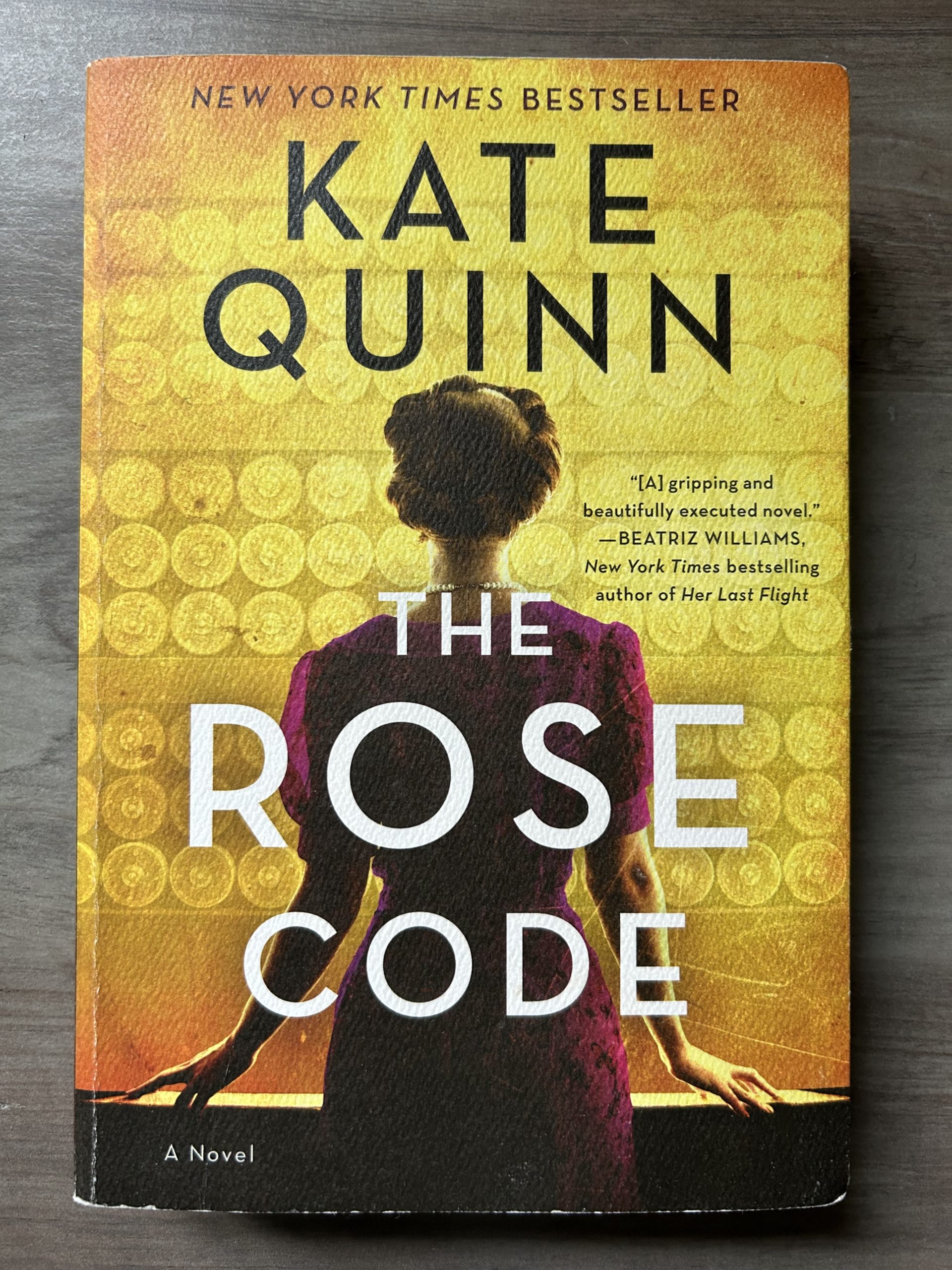
I have debated reading this book for a long time, as I’ve heard many good things about it (both in person and online). A week ago, I finally decided to ask my mother if I could borrow her copy of the book, and I started reading. While The Rose Code wasn’t exactly what I expected, I must say that it was an enjoyable read.
“Women like us don’t get to have a war. We just have to hold everything together.”
Premise of the book:
In 1940, as England prepares for war against the Nazis, three women are picked to go to Bletchley Park, BP, where they will break German military codes. Osla is a wealthy woman who seems to have everything, including Prince Philip of Greece, but she wants nothing more than to help fight for her country. Mab is a factory worker who wishes to find a husband who can help her raise her sister. Beth is a quiet, compliant daughter to her mother and is content with her life being dull and dutiful, or at least that’s what she thought.
Despite being as different as possible, these women manage to find each other and form a close bond. During the tough times of the war, these three friends become enemies as they face betrayal, secrecy, and wartime pressure.
Years later, in 1947, the royal wedding for Princess Elizabeth and Prince Philip was right around the corner. Osla, Mab, and Beth are all living their separate lives. One is engaged, one is married, and one is in an insane asylum. These three old friends, now enemies, must work together to weed out a traitor who was in Bletchley Park and crack one last code.
“Sometimes people who seem ordinary are capable of extraordinary things”
Pros/positives:
*Characters*
The three main characters are all outstanding and so charming. They were even better after learning the jobs they had were based on real jobs that women had during the war.
Seeing all of them handle the pressure they faced and trying to figure out how to deal with what life threw at them was an adventure. This book showed me how different people experienced different struggles through these women’s eyes. Some people lost loved ones, while others were forced to distance themselves from those they loved to keep their work a secret. It took a toll on everyone in a different way. And I must say, I don’t think I could ever work 12 hours on end with minimal to no breaks, but these women had to.
I must admit, the best growth I saw came from Beth. It was so heartwarming to see her flourish from a quiet girl into a strong, opinionated, and happy woman.
The most enjoyable component, for me, was how the side characters actually felt like people. I find that a lot of side characters I’ve read in stories feel flat, but the ones in this novel actually have a life outside of the main characters. We learn that Harry is a devoted father, Gray is a famous war poet, Prince Philip has family issues, etc. Despite having a big cast, the author somehow managed to make me care for many of the side characters.
*Main character friendship*
I have learned over the years that I am a sucker for the ‘unlikely friendships’ trope, and that is exactly what Osla, Mab, and Beth have. They were all pushed together by fate, but they ended up fitting each other so well. I loved how you could see how much they cared for one another.
Osla and Mab supported Beth when she was dealing with her abusive mother; Beth and Mab helped Osla with her romantic life; Beth helped soothe Mab and Osla’s feelings when they were stressed out, etc. My favorite part was watching Osla try to find a husband for Mab. They went as far as to start a club called the Mad Hatters, which was basically a reading club. They all looked out for one another.
Even once they turned into enemies, you could see that they were all trying not to show their concern. They tried to hate each other, but they also refused to turn their backs on one another.
*Code breaking*
Seeing how code breaking worked in World War II from this book was very interesting to me. I didn’t know that there were so many steps to the process, and it was much more complex than I originally thought. The author didn’t go into complete depth about it, but she was able to show some of the separate stages. The author was also able to illustrate the growth of the operation as the military began to find and hire more people.
I think what the author excelled at the most, though, is showing the stress that code breakers had to face during the war. They worked never-ending, horrible hours; the women were paid less than men; the men were spat on for ‘not helping in the war.’ The main stress was the secrecy that people needed to have when it came to their jobs. It took a huge toll on many of the workers. Like, imagine giving birth with no medication (such as an epidural) because you are scared of blabbing while under medication. That’s what one of the characters did in this novel.
*Setting*
I loved learning more about Bletchley Park, also known as BP. It was such a lively setting, and it was constantly growing. Despite the constant addition of new workers, the original workers kept a close, tight-knit community. They all looked out for one another, especially when times got rough. I loved the detail of when Beth’s coworkers made her take a break, since Beth had a habit of getting lost in her work. It was an important detail to show the friendships that people were able to make in these close quarters.
You could also see their closeness because Osla, Mab, and Beth all wanted to believe that there was no traitor at BP, since everyone they worked with was close to one another.
*Split timeline*
This book is split into two timelines: one starting in 1940, and the other starting in 1947. The split timeline kept me very invested in the story. While not much seemed to be happening in the timeline focused on the future (1947), reading about Osla, Mab, and Beth hating each other made me interested in seeing how they split up.
Each time it switched from the 1940 timeline to the 1947 one, I wondered how the characters ended up where they were. Like, finding out who Osla’s fiancé was shocked me, but the more I thought about it, the more sense it made. Meanwhile, figuring out how Beth ended up in the insane asylum was compelling.
I think that the split timelines helped the plot twists land harder. One timeline would reveal a piece of information, and the other timeline would work off of it. It helped build the suspense.
“Life is all about taking risks. You’ll never know what you’re truly capable of unless you dare to try.”
Cons/negatives:
*Decked edges*
My copy of this book has deckled edges, and while that normally doesn’t bother me, for some reason I really struggled to turn the pages. There were many, many times that I would accidentally turn two pages instead of one, and it would throw me off. Maybe it was the way the edges were deckled, or maybe this week just wasn’t my week, but it did get annoying after a few times.
*Romance*
This novel had quite a bit more romance than I would have imagined. When I first picked up this book, I thought that it would focus more on the plot of finding a traitor amongst the code breakers, or on the code breaking itself. While these components were definitely in the story, romance was also a driving factor.
The author put a lot of good thought into the couple pairings, and I have to admit that the romance was cute. However, cutting out some moments from this book could have shortened it quite a bit. The book’s marketing advertised it as a mystery to solve who the traitor was, but that plotline didn’t take charge until 100 pages from the end. There were many times a cute romantic moment would sideline the actual plot.
*Pacing*
The pacing of this book was off for me. The beginning was a little slow, the ending was super fast-paced, and the middle would switch between the two paces. It was tough to want to keep reading the book when some parts felt boring, and others felt exciting. Spreading the plot more throughout the book, rather than restricting it to the end, would improve the story in my mind.
“It is through the darkest times that our true colors shine the brightest.”
Conclusion:
Pros – Characters, main character friendship, code breaking, setting, split timeline
Cons – Deckled edges, romance, pacing
Overall – 3.8 out of 5
“Our stories are not defined by our past, but rather by the choices we make today.”