
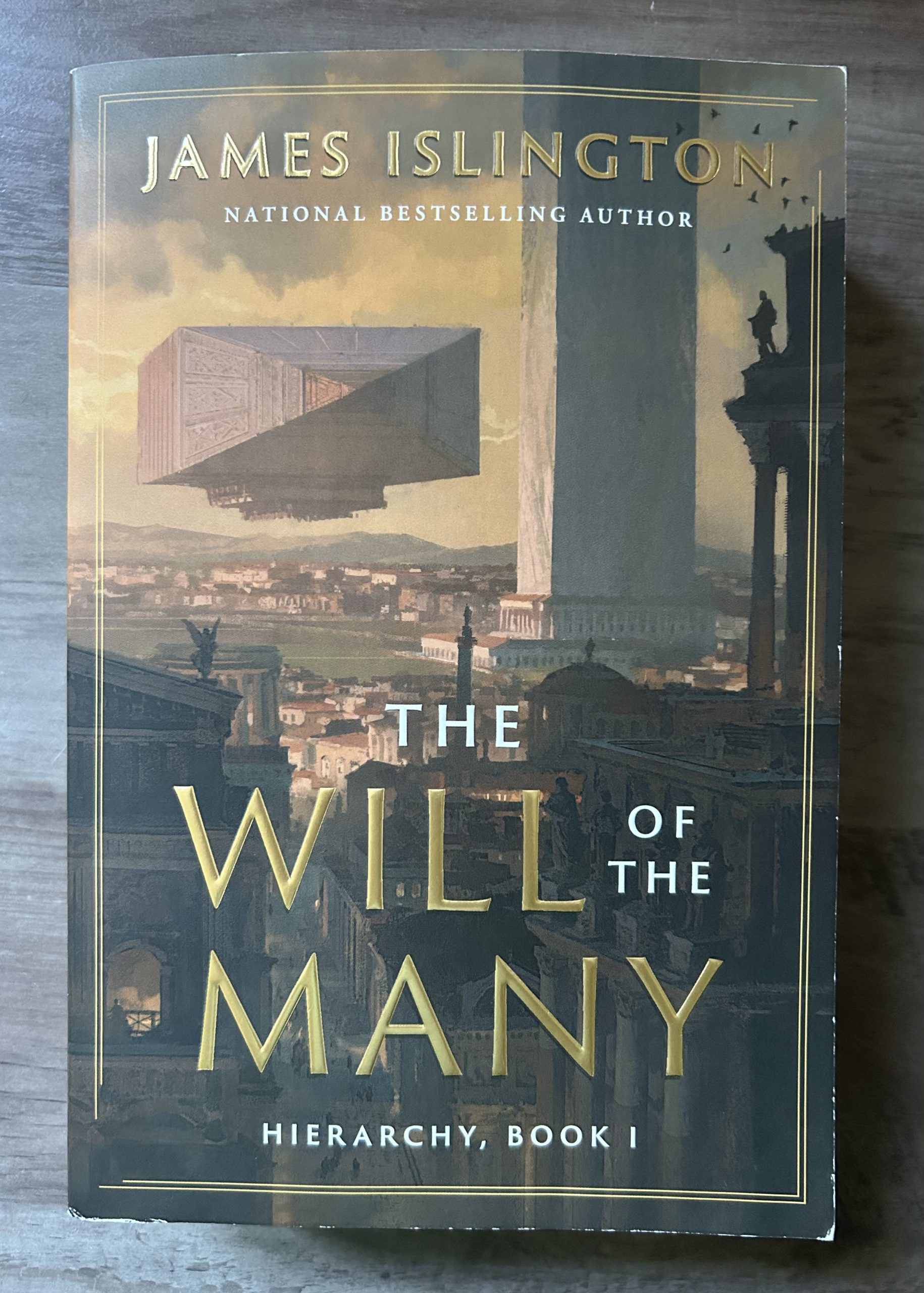
This book was daunting, to say the least, when I first picked it up—the number of pages, the glossary on the back, the number of names. I knew the only chance I had to finish this book was to start it in the summer. I can say with confidence that it was worth every second of the read.
“Nervousness means there’s a fear to be faced ahead, Diago. The man who is never nervous, never does anything hard. The man who is never nervous, never grows.”
Premise of the book:
The Catenan Republic–the Hierarchy–rules over the world. In this Hierarchy, the elite siphons ‘Will’ (physical and mental energy) from the lower classes to make themselves more powerful. However, this siphoning leaves the lower classes weaker. Vis, a boy who was orphaned after the Hierarchy killed his parents, is chosen by Ulciscor Telimus to be adopted into the family. But this adoption has some terms attached. Vis is forced to infiltrate the Hierarchy’s most elite military academy, Catenan Academy, in hopes of finding more information about a death that occurred years ago. Vis must now rise the ranks of the school without raising any suspicion, all while he holds a secret of his own that he is hoping nobody finds out.
“If all you’re trying to do is change who’s in control, then you don’t really want to change anything.”
Pros/positives:
*World building*
The magic system in this book was unlike the usual superpowers of flying, invisibility, and laser eyes, but it was a pyramid scheme. The higher up you are on the pyramid, the more people you can steal ‘Will’ from, which is their physical, mental, and spiritual life force. At the bottom of the pyramid, you have no energy or will to live, but at the top, you are thriving. You can use this Will to get stronger and faster, making you more invincible. Each level of the pyramid has to give half of their Will to the level above them.
Outside of the magic, the world itself was fleshed out. We got some of the history of certain lands, like Suus, alongside traveling to many other lands, with us starting at Letens and ending up at Solivagus. Each setting was well described and thoroughly detailed.
The best part is that I picked it up pretty quickly. I panicked when I saw the ‘Catenan Rankings’ and the long list of names in the glossary, but the author managed to cut the world into manageable pieces.
*Characters*
I enjoyed the characters and their personalities. I have to admit that the main character, Vis, would stress me out a lot. There were many times he was snooping in places that he shouldn’t have been, and the whole time I could only think about what would happen if he was caught. However, I think it added to his character and showed his recklessness. I have to admit that I did like Vis’ moral compass. He refused to bend to the social norms. He even went as far as to basically ruin his social life by sitting with Callidus Ericius, an isolated student who was getting bullied by some stronger students.
The side characters were also interesting. There was always more to them than meets the eye, allowing the reader to imagine what the next character will do. It helped keep the plot unpredictable. It was nice to actually care about side characters for once and hope they make it out alive. I felt especially attached to Callidus Ericius, as he was a very intriguing character to me, and I liked his loyalty.
*Plot*
The plot itself kept me on my toes. The twists and turns were hard to see coming, but they pulled the story together very nicely. I was thoroughly entertained throughout the novel due to the action-packed plot, but I was especially drawn to the ending. I was so focused on the last 150 pages that I didn’t realize how hungry I was until I put the book down after finishing it.
The chapter lengths were good, but even if they were on the longer side, there were a lot of nice spots to pause.
I also loved how the author decided to put the prologue at the back of the novel, compared to just completely deleting it. It gave the reader both more context and allowed us to see more of the author’s thought process. While the author found that the prologue wasn’t a needed addition, I found that adding it at the end of the story strengthened Vis’ character.
*Glossary*
This book’s glossary was one of the best I’ve ever seen. It not only had a list of major characters and locations, but it also provided the pronunciation of everything. I loved being able to look at the character gloss to see how to pronounce their name. If they weren’t on the gloss, then I knew that they wouldn’t be showing up often, if ever again.
“Death is only meaningless if it does not change us, Vis.”
In between/neutral (if needed):
*Mini romance aspect*
I didn’t have the heart to put this in cons because it barely affected the plot, but I couldn’t get myself to enjoy the romance. It didn’t really start until the second half of the book, and it stayed pretty tame compared to the actual plot. However, I couldn’t completely get past the fact that I didn’t care for it. It fell flat for me, like it was there just so that the book could have a romance aspect. It didn’t come close to ruining the book, yet it didn’t feel important to me either. The romance probably continues in the other books in the series, but it felt clunky in this one.
“They know the system is wrong, but they choose not to think or speak up or act because they ultimately hope that in their silence, they will gain. Or at the very least not have to give more than they have already given.”
Cons/negatives:
*Heavy book*
When I call this book heavy, I don’t mean emotionally (although this book did have emotional depth), but I mean in the literal, physical sense. Due to the large number of pages that this book contains, it is…hefty, to say the least. It was awkward at times to carry around, but the worst part is that every time I rested the book on my leg, it would leave a huge dent. It was a cumbersome book, to say the least.
“That’s the problem with people, though, isn’t it? They always think that other people are the problem… If all you’re trying to do is change who’s in control, they you don’t really want to change anything.”
Conclusion:
Pros – World building, characters, plot, glossary
Neutral – Mini romance aspect
Cons – Heavy book
Overall – 4.5 out of 5
“Silence is a statement, Diago. Inaction picks a side. And when those lead to personal benefit, they are complicity.”