
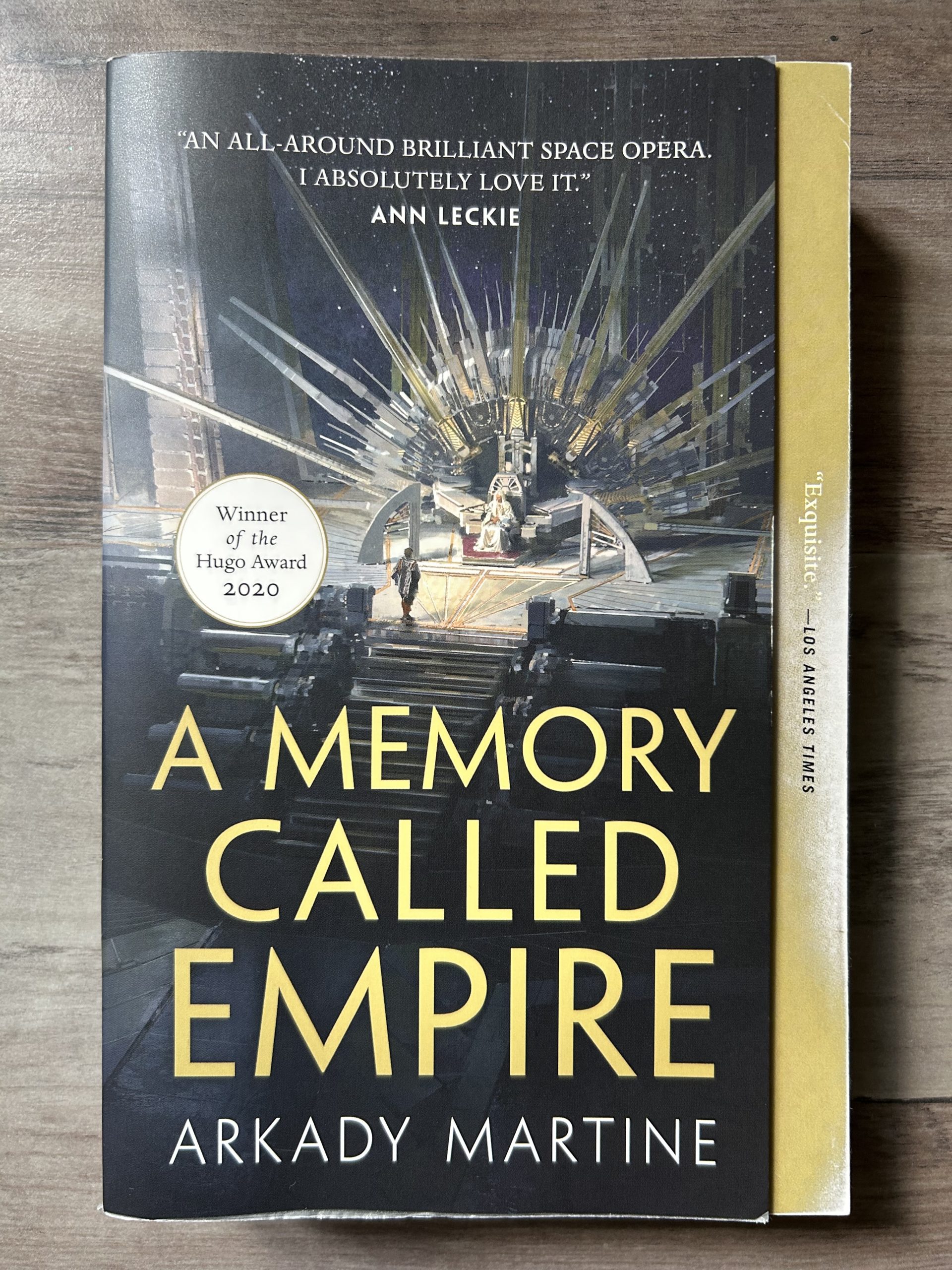
With a breathtaking cover and a memorable title, A Memory Called Empire pulled me into the depths of its story one summer day. While the book ended up not being as entertaining as I first thought, I can’t say I regret giving it a try.
“Nothing touched by Empire stays clean.”
Premise of the book:
Mahit Dzmare is excited when she learns she is chosen to become the new Ambassador from Lsel Station for the Empire. That excitement tampers out when she gets to the capital and learns that her predecessor had been murdered, although everybody seems to be treating it as an accident. In this new city, Mahit must figure out who murdered the last Ambassador, all while making sure the independent mining station she came from doesn’t get lost in the expansion of the Empire. She also most make sure the illegal technology she has on her stays hidden from the Empire.
“An algorithm’s only as perfect as the person designing it.”
Pros/positives:
*World building*
The book had an extensive amount of work put into the world around Mahit. While it could be confusing and overwhelming at times, I can’t take away the credit from the author, since I can see how much work they put into making this. The glossary in the back became my best friend during my reading time. Not only does the glossary contain a list of important people, places, and objects, but it also includes a guide on the pronunciation and writing system of the language of Teixcalaanli.
The politics in this book are also very thought-out and woven together. Chapters seven and eight, in which Mahit goes to a party of sorts, are where you can really notice the politics working. Each character interacts with the others strategically, but in a unique way: through poetry. Much of the conversation in these chapters surrounds the fact that people from Teixcalaanli use poetry to get their point across. Like how, in a poetry competition, Mahit was confused about a poem someone created, but her cultural liaison tells her that it was for “politics” and “a critique” of the Empire. Marathi later recognizes it as “politics by means of literary analysis” (175).
The naming system in this story is also creative. Each name has two parts. The first part is a number, while the second part is a noun. For example, Three Seagrass is the name of the cultural liaison that follows Mahit around. Sometimes the name reflects a person’s family background, as Three Seagrass does, while other times it has more symbolic meaning, such as the character Twelve Direction.
*Ending*
The most interesting part of this book for me was at the very end. I couldn’t say I cared much for the plot up until the last couple of chapters, but once the plot amped up, I was curious to see where it was going. The ending itself was enough to leave me satisfied, but I can’t say I will be moving on to the sequel that has been released.
However, I can appreciate how this book centered its attention on the fantasy aspect, compared to drifting off to a different topic, like romance.
“So much of who we are is what we remember and retell,”
Cons/negatives:
*Needed to be focused*
Due to the complexity of the world, I needed to be as focused as I could when I read. I found myself rereading many of the paragraphs just to make sure that I understood what was happening, who was introduced, etc. Even though the world was intriguing to learn about, there were times when I couldn’t comprehend what was going on due to not being engrossed enough.
*Plot*
As much as I enjoyed the world-building, I felt like sometimes the plot was lost so that the book’s political system could be built up. Occasionally, I’d forget the murder mystery aspect of the story because I was so concentrated on understanding the world.
The plot itself wasn’t even that entertaining for me. My boredom with the plot got to a point where, when the murder of the past Ambassador was revealed, I found that I didn’t even care. I just kept reading, waiting for the book to end.
It definitely didn’t help that the chapters were so, so long. If every chapter were divided evenly in this book, each chapter would be a bit less than 21 pages. The fact that I wasn’t too invested in the story made each chapter feel like a battle of its own to get through. The elongated chapters made me not want to pick up the book to begin with.
*Characters*
I hate to say it, but I didn’t really care or connect to any of the characters. A lot of the time, I mixed up most of them in my head, with the only characters I remember being Three Seagrass and Mahit. I wasn’t happy when a character died, but I wasn’t sad either. No strong emotions were elicited when I read.
On a side note, I have no clue what Mahit’s actual job is. Like, what are Ambassadors supposed to do??? It seemed like Mahit was just getting dragged from one spot to another, and when she was sitting still, she used it as time to solve the murder of her predecessor.
“Our memory is a more perfect world than the universe; it gives life back to those who no longer exist.”
Conclusion:
Pros – World building, ending
Cons – Needed to be focused, plot, characters
Overall – 2.5 out of 5
“Poetry is for the desperate, and for people who have grown old enough to have something to say.”