
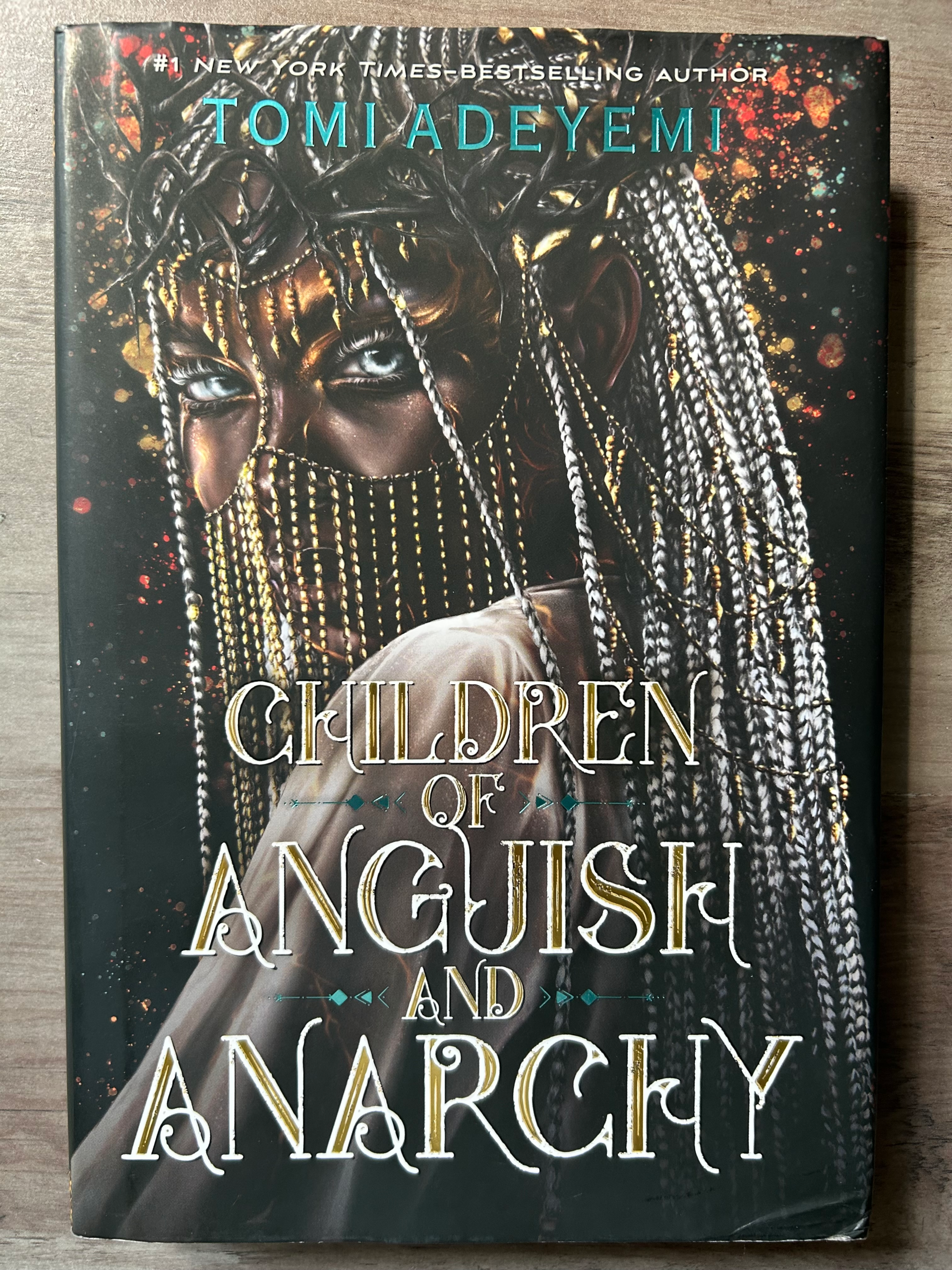
Children of Anguish and Anarchy by Tomi Adeyemi was my most anticipated book release of 2024, as for many fans of the series. I patiently waited three years for this book to be released, counting down the days to June 25th, 2024. Imagine my disappointment when I realized that this book isn’t all that it’s cracked up to be. It’s like your favorite show being ruined in the last episode; the season finale demolishing all of your hopes and dreams. It falls short in almost every aspect that I loved from the first books in the trilogy.
“I teach you to be warriors in the garden, so that you may never be gardeners in a war.”
Premise of the book:
After seizing the palace, Zélie Adebola finds herself stuck in a cage on a ship out at sea, far away from her home. She learns her captor, King Baldyr, the ruler of the Skulls, is after her magic, wanting to become unstoppable. Zélie must now make alliances with the people of these unknown lands to try to stop King Baldyr before he becomes invincible.
“We’ve brought our kingdom to its knees, and now their fiercest are at our door. How many of our fiercest lie in the ground?”
Pros/positives:
*Cover and title*
The cover and title of this book are breathtaking. I love how all of the titles and covers in this series connect. It makes it more aesthetic.
*Writing style*
Despite all of the complaining I am about to do, the writing style in this book was still so captivating, just like with the other two books. Without it, I probably wouldn’t have been able to finish this book.
“I’ve lost count of how many times over the past moon I’ve called out to my gods. How many times nothing but sorrow has answered in return. I cannot bear to hope anymore.”
Cons/negatives:
*World building/setting*
New lands were introduced in this story, and they had some (minimal) depth, which I will give credit for since I found nothing else in this book to be interesting. The issue is that the lands still lacked for me. If the author wants to change the setting so badly, she has to make it better than the one we just came from. I feel like this book had 100 more pages (at least), it would have been better.
Orïsha, the original land Zélie was kidnapped from, was barely mentioned in this story, despite the fact that it was a major plot point in the other two books. Losing the setting of Orïsha was like losing a cherished antique—an irreplaceable spot filled with heartwarming memories that became nothing more than a forgotten place.
The unrealistic travel times ruined my immersion in the story. It took only a few pages, which felt like minutes, to cross literal oceans.
*Characters*
The first two books pulled me in with their unique characters, but as I was reading the first few chapters of this book, I felt a change in all of their personalities. I tried to give it the benefit of the doubt until I realized that all of the character development got thrown out the window! Some of the characters, like Roën, completely disappeared. Where did he go? Well, nobody can tell you, not even the author. The book only briefly mentions him twice, despite the fact that he had a big role in the second book. One of those times being the main character, Zélie, “wonder[ing] where he is,” (117) which leaves his fate unknown for the rest of the story, an open-end where there shouldn’t be one.
Some characters suddenly lost the growth that they had spent the last two books gaining. For example, Zélie spent her whole journey gaining and coming to terms with her magic, just for her to immediately lose it. It was a big letdown, ruining her progress in accepting herself. The constant POV switches between four different characters prevented me from being able to actually get to know any of the characters. Even though I followed three of them (Zélie, Amari, and Inan) in the previous books, they felt like new characters in this novel, ones I will never get to know.
Along with the minimal character development, the villain of the book is basic. He is so generic that I don’t even remember his name unless I look at the book. His goal for the whole book is to gain powers so that he can become a god. Where have I heard that before? Maybe in almost every book under the sun. What happened to the creative drive that the last two books had? His lack of depth made the plot fall short and become mediocre since every time he was mentioned in the book, it was like a record playing on repeat. It made this book slip back into every other general fantasy book I’ve ever read.
Don’t even get me started on how every character all of a sudden wanted a redemption arc. For starters, Inan’s redemption arc was probably the saddest thing I’ve ever seen. He became a Zuko wanna be. Yet, my main issue was that everybody was just forgiving all of the characters that had done horrible things. One of the people literally started a war and killed thousands, but don’t worry, everybody excused them for their crimes. Like, am I the only person who holds a grudge? Are we just forgiving everyone under the sun?
*Romance*
The romance hits the fan in this story, and I wish I were exaggerating. I feel like the author threw in gay romance just to have it. There was no buildup, just a couple of ‘flirty’ scenes, which disappointed me because I love finding queer romance in novels.
Worst of all, these new relationships ruined the dynamics established in the last two books. There was so much build-up for Amari and Tzain, and I thought they would end up together. Little did I know that Amari would fall for a woman introduced in this novel instead. I am complaining because the execution was bad. Even if the author didn’t want Amari and Tzain to date, I think it would have been much better if they both agreed not to date. There is no need for an extra love interest. However, if you want to add an extra love interest, you have to make the relationship desirable to the audience. Make the two actually have chemistry, compared to just forcing them together.
*Plot*
This plot didn’t connect with the rest of the trilogy. The war between the maji (a group of people who were being discriminated against by the royals because of their magic) and the monarchy was sidelined, with the two sides coming together to ‘defeat a common enemy’ (stupid!). What makes me more upset is that the maji themselves were sidelined, even though the other books were literally about the oppression they face! If you ask me, that’s quite ironic. I mean, how did we end up here???
The main hitch I had with the character development was the quick changes in POVs. We followed four separate perspectives with quick-moving chapters, with each chapter being no more than 10 pages long (you know it is bad when I’m complaining about chapters being too short). I felt that the short chapters forced the story to keep moving, all while leaving the reader behind.
While the ending was hopeful and supposedly heartwarming, I couldn’t bring myself to care. I was too busy trying to catch up on all that had changed from the last book to this one.
“The name of my goddess fills me. It moves something in my soul. Her brewing storm calls out to me like a song. It holds the promise to make me whole.”
Conclusion:
Pros – Cover and title, writing style
Cons – Worldbuilding/setting, characters, romance, plot
Overall – 0.25 out of 5
“A promise that my people could be more than the mere mortals we were born as. A promise that we could become gods.”