
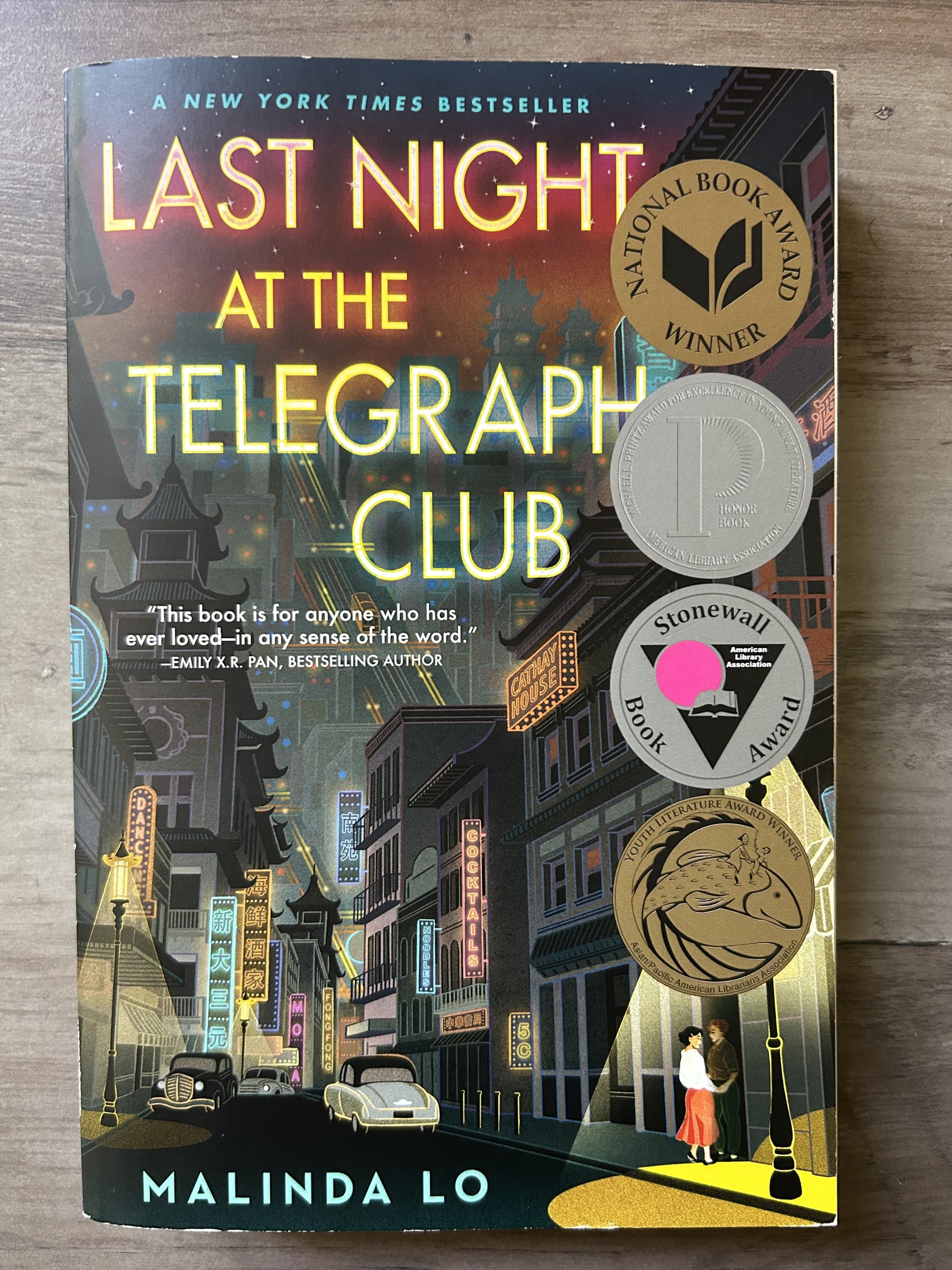
While I don’t usually read historical fiction or romance, I found Last Night at the Telegraph Club to be an authentic coming-of-age story, with a tender sapphic relationship.
“The word felt dangerous, and also powerful, as if uttering it would summon someone or something.”
Premise of the book:
Lily Hu, a Chinese American who lives in Chinatown, starts to question her sexuality one day after seeing an ad for the Telegraph Club. In hopes of finding some answers, she goes to that exact club with one of her classmates, Kath. While Lily is trying to find out more about herself, she realizes that she is falling for Kath, all while her father faces the threat of deportation. But 1954 is a dangerous time for queer people. Lily must figure out how much love means to her.
“She didn’t understand the shrinking feeling inside her, as if she shouldn’t be caught looking at those girls.”
Positives:
*Main character*
The main character, Lily, is a solid, well-written character. She felt like a normal teenager. In many ways, I saw myself in her. She didn’t want to go against her parents, but she refused to not be herself. I related to her the most in her struggle to understand and grasp her sexuality. She felt realistic in the journey she took to find a new part of her identity. However, what I liked most about her was her personality. I find that most teenage main characters nowadays are a weird mix of stereotypes of what people believe teenagers act like. Lily was authentic. She was both shy and naive, while also being courageous. It was easy to want to root for her.
*Romance*
The romance in this story captures the essence of a ‘first relationship.’ It illustrates the feeling of young love and affection. The author does a fantastic job of depicting the hesitance that one goes through when stepping into new territories in a relationship. I love how you can see the switch in Lily’s energy whenever she’s around Kath. Lily is allowed to be herself without any judgment. They make such a cute pair, with both of them harboring a steadfast love for one another.
*Themes/issues that the book faces*
I enjoyed the dive into the deep themes that this book talked about. I don’t normally read historical fiction, for whatever reason, but I always tend to appreciate the problems that the genre deals with. This book had a focus on homophobia and the threat that queer people faced in the 1950s, but it also went into racism (like microaggressions) and issues of deportation. The accuracy with which this book depicts these issues is realistic. It pays attention to the small details, such as Lily not wanting to ask a store clerk for help due to past racism she’s faced, or how people kept asking Lily if she spoke English.
I thought that the way Lily went about discovering her sexuality and facing the obstacles that came with it was life-like and relatable. One of the scenes that really stuck out to me was when Lily realized a boy, Will, was about to ask her out to the school dance. Instead of feeling excited, Lily felt “a horrified heat creeping up her neck” (pg 52) from fear. To get out of that situation, she did what anyone would: run to the bathroom and wait for Will to leave the school. Was it the best way to handle the problem? No, but I believe that it increased the authenticity of the book, as that is how I imagine myself reacting to panic. It makes the book seem more alive in my eyes.
*Writing style*
The writing style was immersive for me. You can see the research that the author put into making the book in both the author’s note and the book itself. The author uses time-accurate words, including the word ‘oriental’, which was used prominently in the 1950s to reference Asian Americans. Nowadays, it is seen as an offensive word. She also made sure to research Chinatown and queer communities in the 1950s.
I welcomed the simple words used in the book, with the author taking the time to set up not only the physical area of a space, but also the sense of it. The reader is transported to the world that Lily lives in without the use of fancy metaphors or huge terms. It’s in the way the author describes the details, like how the “Telegraph Club’s white neon sign was smaller than Lily had expected” (pg 143), or how the clothes Lily wore to the club smelled like “the bar itself—a stale, boozy scent”, making her want to “preserve it like a piece of evidence” (pg 165).
I appreciated the short chapters that went by quickly, and I loved the footnotes that helped define words or translate those that I was unfamiliar with.
*Setting*
Chinatown had a lively atmosphere. The familiarity that Lily felt with the area rubbed off on the reader as they went through this novel. I appreciated how the author depicts the negatives of small community gossip and how it impacted people like Lily. You couldn’t do anything without someone you know seeing it.
The Telegraph Club itself was a good representation of finding a safe space in an unexpected area. It was a place where queer people could just exist for a few hours without worry, and that exact casual ambiance easily got caught by the reader.
“Lily raised her fingers to her lips as if to touch the last trace of Kath’s mouth on hers. She felt a queer giddiness overtaking her, as if her body might float up from the ground because she was so buoyant with this lightness, this love.”
In between/neutral:
*Plot*
I thought the plot would be slightly different than what it ended up being. When reading the summary on the back, I imagined that there would be more on Kath and Lily, alongside the fact that I thought the issue of deportation would take over a lot more of the plot. In reality, Lily’s father got his citizenship papers taken, but nothing more than that was mentioned. It was minimally brought up, more as just a side thought than a pressing, constant issue. The book also tended to focus more on Lily and her coming to terms with her sexuality. It falls more into a coming-of-age story. While the actual plot wasn’t even close to bad, it just wasn’t what I was expecting.
*Ending*
While I did enjoy the ending, I wish we had gotten a few more pages added to this novel. Lily went through a huge change right before the epilogue, but we never cover the immediate aftermath, just a glance at her life one year later. I would have been interested in seeing how Lily handled the change.
*Pacing*
A few parts of this book were slower than others. Since I’m a fast reader, I breezed past the slow parts, but after I finished the novel and reflected on it, I realized that some sections weren’t as impactful to me as others.
“Perhaps that was the most perverse part of this: the inside-outness of everything, as if denial would make it go away, when it only made the pain in her chest tighten, when it only made her emotions clearer.”
Negatives:
*Side characters*
Some of the side characters weren’t expanded upon as much as others. For example, I felt as though I both knew everything and nothing about Kath. I know she loves airplanes, is good at math, and has a younger sister. Yet, I don’t know what happened to her for most of the end of the book up to the epilogue. At the end of the book, I don’t know how everything has affected her compared to Lily.
I also believe that, while we got some good scenes of the woman at the Telegraph Club, I would have loved a little more. Some of them were very similar to one another, leading to me sometimes confuse a few of them with each other.
*POV switch*
At the end of each section, there was a POV switch to someone in Lily’s family (her mother, father, or aunt), and it was always only for one chapter. While I can see some of the importance of this, I can’t say I loved reading them. It interrupted my flow, and it didn’t expand as much on some of the characters as I could have wished for.
“She’s having a hard time right now because you’re not what she expected. But we’re never what our parents expected. They have to learn that lesson.”
Conclusion:
Pros – Main character, romance, themes/issues that the book faces, writing style, setting
In between – Plot, ending, pacing
Cons – Side characters, POV switch
Overall – 4 out of 5 stars. I’d recommend this if you were looking for a deep and tender story about finding your own identity.
“‘It was about two women.’ Lily’s mouth felt so dry she might choke on the words. ‘That book, Strange Season. It was about two women, and they fell in love with each other.’ And then she asked the question that had taken root in her, that was even now unfurling its eaves and demanding to be shown the sun: ‘Have you ever heard of such a thing?’”